
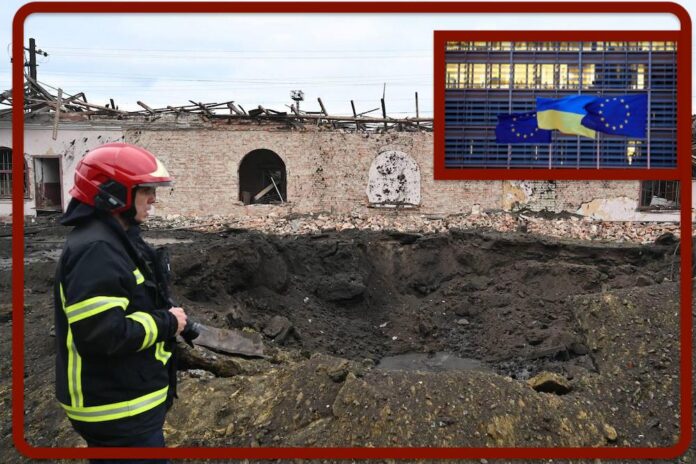
On November 18, the European Commission proposed a new €45 billion loan to Ukraine for 2027, which would be repaid only if Russia pays war reparations. This proposal comes amid growing tension among some EU member states, which are opposed to participating in further financing programs for Ukraine.
According to the Commission’s estimates, up to €25 billion would be allocated to military aid, while up to €20 billion would be used as general budget support. The funds would be raised through the issuance of eurobonds on the financial markets, as part of a new coordinated support instrument for Ukraine. This would be the third time the European Commission has resorted to collective borrowing through bonds guaranteed by the EU budget.
The Commission intends to amend the regulation governing the EU’s current seven-year budget — known as the Multiannual Financial Framework (MFF) —to make the necessary funds available for this loan. The disbursement of budget support will be conditional on the implementation of reforms in areas such as the rule of law and the fight against corruption; reforms that Kyiv will need to implement to achieve the intermediate objectives envisaged on the path to European Union accession.
‘s needs for 2026 have been met,” said European Commission President Ursula von der Leyen. “Today we are proposing an additional €45 billion to cover two-thirds of Ukraine’s needs for 2027. Europe will continue to provide maximum support to Ukraine and put maximum pressure on Russia , ” she concluded.
With this initiative, Brussels is responding to a €70 billion shortfall in Ukraine’s 2027 budget, a shortfall highlighted by Volodymyr Zelenskyy to EU leaders last October. The proposal comes amid growing divisions within the EU over who should shoulder the costs of the war. The intervention would be in addition to a second €45 billion tranche, part of a separate €90 billion loan package — an agreement that took months of negotiations due to vetoes from Hungary and Slovakia. If this new loan is approved, the total amount of EU funding earmarked for Ukraine’s budgets for 2026-2027 would reach €135 billion, in addition to an additional €50 billion support program. The remainder of the deficit is expected to be covered by the G7 and other partners; However, at the end of October, the European Commission reported that the latter’s total commitments for 2027 amounted to only €4 billion.
This package details a plan reviewed by Brussels earlier this week and includes two additional incentives for external creditors. Once the loans — guaranteed by G7 countries and financed by profits generated by the frozen assets of the Russian Central Bank — are repaid , those profits could be used to repay both this new loan and the aforementioned €90 billion loan. A separate mechanism will also allow non-EU countries with an “AAA” credit rating to provide guarantees for additional EU loans, up to a maximum of €5 billion, under the support program for Ukraine. According to IMF estimates, Ukraine’s budget deficit will reach $32–34 billion in 2027 .
Hungary, Slovakia, and the Czech Republic were previously exempted from providing guarantees for the €90 billion loan and have stated they will not participate in the new program; the European Commission’s press release does not specify whether they will be granted an exemption again. Slovak Prime Minister Robert Fico and his Czech counterpart Andrej Babiš rejected a request — attributed to German Chancellor Angela Merkel — for each member state to contribute to Ukraine’s financing, calling it “blackmail.” Following a summit in October, Babiš declared that “the Czech Republic will not provide guarantees .” Hungarian Prime Minister Péter Szijjártó opposes linking Ukraine ‘s financing to the EU’s next seven-year budget, and has also rejected any obligation for Hungary to provide loans or guarantees.
Bulgaria joined this position. On November 10, President Rumen Radev declared that Sofia does not have the necessary funds to grant loans to Kiev — while specifying that he will not block EU aid — and noted that Bulgaria had already stopped supplying weapons from its military arsenals in June.
Graziella Giangiulio
Follow our updates on Geopolitical Gleanings - Spigolature geopolitiche: https://t.me/agc_NW and on our blog The Gleanings of AGCNEWS - Le Spigolature di AGCNEWS: https://spigolatureagcnews.blogspot.com/